

A bettor checking a Kalshi price for the same NFL game sees 56 cents on Tuesday, 56 cents on Wednesday, then 55 cents on Thursday. Nothing about the game changed. The question that follows is simple: who moved it?
Nobody at Kalshi sets the number. Every market is an order book, built from offers traders post themselves, and this page explains how those offers turn into the price a bettor sees, what makes it move, what makes it hold still, and what the number can’t tell you about how much is actually for sale at it.
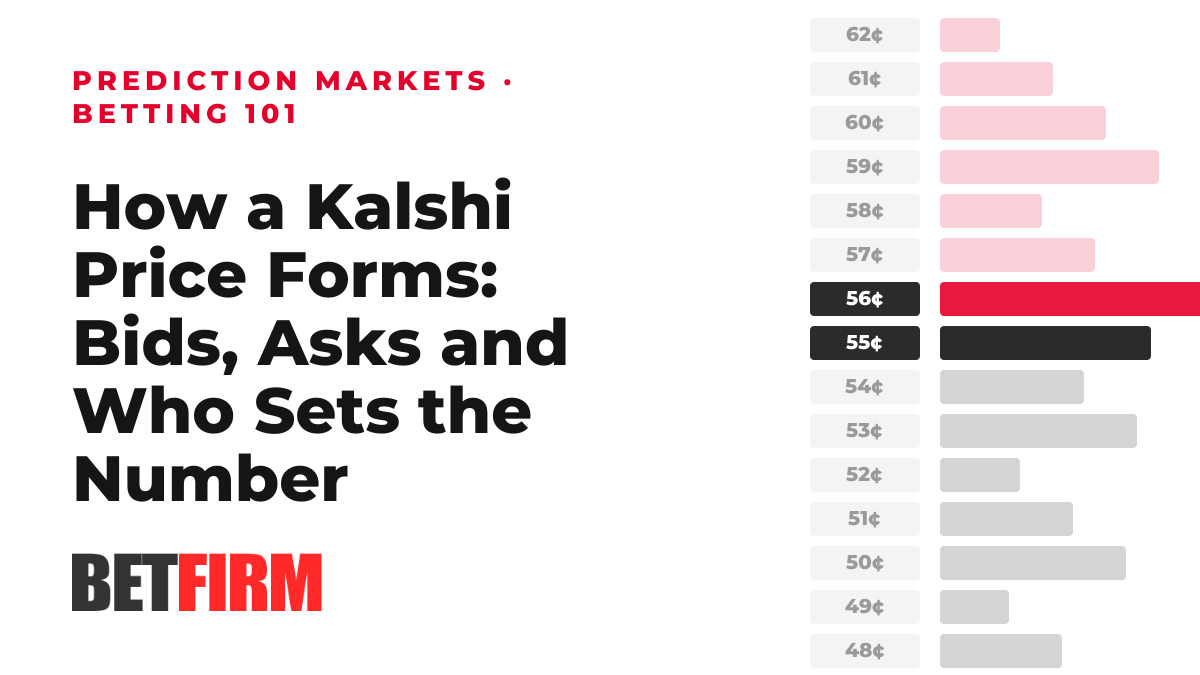
A Kalshi market has no house price. It has an order book: a list of offers to buy (bids) and offers to sell (asks), each posted by a trader at a price that trader chose. The bid is the highest price any buyer has posted. The ask is the lowest price any seller has posted. The price a bettor sees sits between those two.
The trader who posts an offer and waits is the maker. The trader who comes along and accepts that offer is the taker. A trade only happens when a taker accepts a posted price, or when a new order crosses one already sitting in the book.
That means the price moves for one of three reasons: someone adds a new order at a better price, someone pulls an order off the book, or someone takes an order that was already there. A price that hasn’t moved in a day means none of those three things happened. It does not mean any trader judged the number correct. It can just mean nobody traded.
The table below follows the Saints market for Atlanta Falcons at New Orleans Saints, played Monday, October 5, 2026. The Saints were the sportsbooks’ favorite that week, and the price moved down almost every day as kickoff got closer.
On Tuesday, September 29, the bid sat at 58 cents and the ask at 59, a mid of 58.5, close to the sportsbooks’ fair price of 58.3 cents. By Saturday, October 3, the mid had fallen to 54.5, matching the books’ fair price exactly that day. By kickoff Monday, the mid had dropped further to 52.5 while the sportsbooks still had the Saints at 54.5.
What stands out is the trading, not just the price. Through the week contracts traded climbed from 96,172 on Tuesday to 339,459 by Sunday, then jumped to 4.5 million by game day. The price drifted a few cents over six days and then moved on heavy volume the day it mattered. The Falcons won.
| Reading | Bid | Ask | Mid | Books’ fair price | Contracts traded |
|---|---|---|---|---|---|
| September 29 | 58c | 59c | 58.5c | 58.3c | 96,172 |
| September 30 | 56c | 57c | 56.5c | 57.2c | 108,952 |
| October 1 | 55c | 56c | 55.5c | 56.6c | 147,614 |
| October 2 | 55c | 56c | 55.5c | 56.6c | 172,079 |
| October 3 | 54c | 55c | 54.5c | 54.5c | 210,654 |
| October 4 | 53c | 54c | 53.5c | 54.5c | 339,459 |
| October 5 | 52c | 53c | 52.5c | 54.5c | 4.5 million |
Played Monday, October 5, 2026. One reading a day, the last one the hub took that day; contracts traded counts both teams’ markets.
Every NFL game on Kalshi has two markets, one for each team. Outside of a tie, a Yes on one team and a No on the other pay off in exactly the same games, which keeps the two prices tied to each other even though they trade separately.
Buying both teams at their asks cost 100.8 cents on average before fees for a payout that’s certain to be $1 no matter who wins. Selling both teams at their bids brought in 98.8 cents. The two teams’ mid prices add up to about 100, which is what ties them together: if one side drifts, the other side has room to move the opposite way without the pair falling out of line.
On NFL game winner markets, the gap between bid and ask sat at exactly one cent in 618 of 634 readings taken during game week, with the widest gap seen at two cents and an average of one cent. Spreads and totals markets showed the same one-cent gap at the last reading. A one-cent spread is a small cost to cross.
That gap widens the further out a game is. On a single Tuesday reading taken October 13, 2026, games within a week of kickoff averaged a one-cent spread across 28 markets, while games 8 to 14 days out averaged 4.4 cents across 28 markets. The spread narrows as the game, and the trading, gets closer, which is what the table below shows: contracts traded per game climbed from 179,900 at five days out to 1.7 million at the last reading before kickoff, while the spread held near one cent the whole way.
The spread is only part of the cost. The fee a taker pays is 0.07 times the price times one minus the price, per contract, and it’s largest at 50 cents, where it runs 1.8 cents per contract on a 100-contract order. At 10 cents it’s 0.6 cents per contract, at 25 cents it’s 1.3, at 75 cents it’s back down to 1.3, and at 90 cents it’s 0.6. That fee, not the spread alone, is the cost a taker actually feels on a trade.
| Reading | Games | Bid-ask spread | Contracts traded per game |
|---|---|---|---|
| 5 days before | 58 | 1.1c | 179,900 |
| 4 days before | 58 | 1.1c | 255,306 |
| 3 days before | 59 | 1c | 326,702 |
| 2 days before | 63 | 1c | 531,883 |
| The day before | 63 | 1c | 737,881 |
| Last reading before kickoff | 63 | 1c | 1.7 million |
Weeks 2 through 5 of the 2026 NFL season: 63 games played from September 17 to October 12, 2026. Averages across the games read that day.
The bid and ask tell a bettor the best price available, not how much is available at it. A reading of the best bid and ask twice a day doesn’t record how many contracts are resting there, so a large order can fill partly at the ask shown and partly at worse prices above it as that first offer runs out.
A quiet price, one that hasn’t moved in a day or two, means no trade crossed it. It doesn’t mean the market agrees with it, and it doesn’t mean size is waiting there to be taken at that level. Sports contracts also aren’t offered in every state, which is worth checking before relying on any of these numbers for a specific game.
See also: Kalshi vs. the sportsbooks: this week’s NFL games · How to read a Kalshi price · Kalshi payout and fee calculator.